Globally, over 11 million people are in prison today.
Imprisonment is one of the most severe forms of punishment in contemporary society. It materializes state power through space, architecture, and institutional control. Prison architecture is therefore not merely a technical or functional matter—it plays a central role in how punishment is produced and experienced. Through walls, corridors, cells, surveillance points, light, sound, and material conditions, it organizes bodies in space and shapes how incarcerated individuals experience time, movement, privacy, relation, and constraint.
The prison is both a built environment and a social instrument: it gives physical form to ideas about order, discipline, and between those seen as law-abiding and those labeled deviant.
For a more extensive version of this chapter, download the full text.
Despite the common perception of a clear boundary between the prison “inside” and society “outside,” prisons are by no means cut off from the rest of society. The appearance created by high walls and remote locations is misleading. The spatiality of prisons interacts with and is embedded in political, economic, social, and cultural contexts. Through the circulation of objects, money, legal decisions, labor, and people, prisons remain in continuous exchange with the society beyond their walls. They are not isolated places, but part of a wider network that connects the prison to the home, the neighborhood, the court, and the school.
The idea that prisons have little to do with those who live outside them is therefore mistaken. As members of a society shaped by specific values, norms, and political choices, we are all at least implicated in the penal system that these forces produce and sustain. This system is both a product ofour world and an institution whose effects are deeply interwoven with society. For this reason, incarceration affects us all—yet we often fail to recognizethe connection between the prison system and the values upheld by the societyof which we are a part.
Prisons give physical form to punishment—but they are also tied to processes that sort and target specific social groups, determining who is more likely to be controlled through confinement. Punishment is not a neutral legal instrument. It is shaped by social values, moral boundaries, and existing power relations. Crime is often framed as an abnormal deviation from a shared moral order, while those who commit crimes are constructed as an “enemy within”—people who must be controlled, disciplined, and excluded.
Over recent decades, many societies have seen a sharp increase in state control, criminalization, and incarceration. Ideals of rehabilitation and social welfare have increasingly given way to surveillance, discipline, and punishment. This shift has not affected everyone equally. While corporations and wealthier populations are largely granted freedom and support, poorer and marginalized groups are disproportionately subjected to discipline and confinement.
The question of what gets punished often conceals the more important question of who gets punished. Punishment is not distributed equally across society. The presumed tight linkbetween crime and punishment is, in fact, quite weak: many crimes receive nosanction, and many punishments are imposed without a corresponding crime. Offenses associated with economic or elite actors are frequently dealt with administratively, while crimes committed out of poverty or necessity—such as theft—are punished more harshly.
Money laundering linked to drug trafficking, for instance, is prosecuted with a high likelihood of conviction, while fraud or corruption cases—despite being more frequent and involving far larger sums—are pursued less rigorously. Punishment, in other words, is determined not only by the actitself, but also by the social position of the person who commits it.
Public narratives about “poverty migration” or “refusalto integrate” further legitimize these patterns, framing a lack of safety in society as a problem of individual deviance rather than structural inequality. Crime can be understood as a symptom of deeper social inequalities—while punishment creates an illusion of fairness that conceals and reproduces those same injustices. As Angela Davis writes, prison “relieves us of the responsibility of seriously engaging with the problems of our society, especially those produced by racism and, increasingly, global capitalism.”
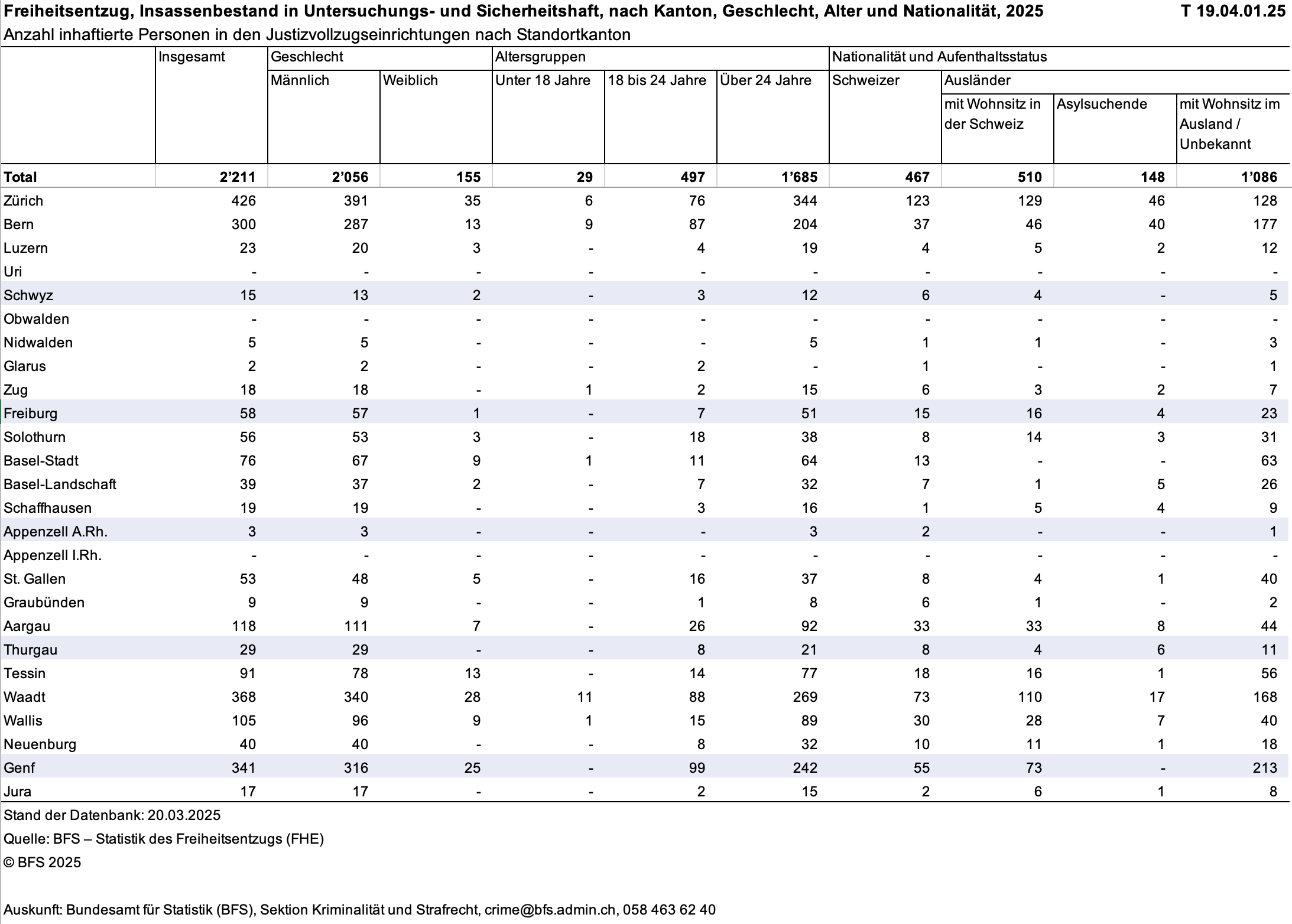
The unequal distribution of punishment described above is not an abstract or distant phenomenon. It is clearly visible within the Swiss penals ystem.
In Switzerland, patterns of punishment reveal a stark overrepresentation of non-citizens and socially disadvantaged groups. In 2025, 78% of individuals in pre-trial detention were not Swiss nationals. Among them, 29% held a residence permit, 8.5% were asylum seekers, and for 62% the place of residence was unknown. People without a migration background constitute a minority among detainees.
This cannot be explained by any higher rate of criminality among foreigners. It reflects structural mechanisms within the justice system. Two dynamics are particularly relevant: direct and indirect discrimination—including racial profiling and the systematic use of pre-trial detention on the grounds of “risk of flight”—and restricted access to alternatives to imprisonment such as community service or electronic monitoring.
Prison architecture, in this context, is part of a wider system of unequal social categorization. The cell, the detention wing, the surveillance corridor, and the institutional routine are not experienced by a randomcross-section of society. They are disproportionately imposed on people already affected by migration status, poverty, and social exclusion. The spatial experience of imprisonment is inseparable from the inequalities that determine who ends up inside in the first place.
Recent penal reforms have further intensified these disparities. Since the 2000s, the Swiss penal system has increasingly relied on monetary penalties. Although these fines are formally adjusted to income, they often exceed what poorer individuals can pay—and are subsequently converted into prison sentences. In 2022, approximately half of all incarcerations resulted from such conversions. Economic disadvantage, much like non-citizen status, significantly increases the likelihood of ending up in prison.
Being in—Coping With Space