Prison architecture gives physical form to ideas about order, discipline, and control. This chapter looks at objects, architectural elements, and spaces encountered during my field research, examining them as material traces through which the penal system becomes visible. It also draws on an interview conducted with ST, Project Manager of the Pilot Project Pre-trial Detention Zurich/Bern, and KR, Prison Director—both of whom provided frank insights into the workings of pre-trial detention and the efforts being made to reform it.
For a more extensive version of this chapter, download the full text.

Orange Dot Stickers, Documented during Field Research at Correctional Facility, 2025
Spatiality and External Control
The prison environment actively organizes and restricts movement through a dense network of doors, locks, fences, and coded access systems. Movement becomes dependent on institutional permission rather than individual decision-making. As KR notes: “Many fall into crisis as a result of the strong external control within the prison, because they can no longer decide for themselves what to do.”
We are guided through the regular detention unit in small groups. Every door inthe building has multiple locks. Next to each lock, there is a white or orange circular sticker. I ask the staff member what it means, but he avoids thequestion and doesn't give an answer. Presumably, the colors are technical markings related to the locking system. (Field Report Correctional Facility)
The orange and white dots next to each lock point to the underlying complexity of the prison's locking system. The unusually high number of doors requires an additional visual code to guide staff—indicating how profoundly movement through the building is structured and controlled. This layered system of barriers not only regulates access but also governs the pace and rhythm ofthe body, slowing it down and fragmenting movement into controlled sequences.
This spatial organization shapes social relations and everyday experience too. Living in close proximity over extended periods intensifies interpersonal tensions. When people are confined together for weeks or months, the lack of choice in social interaction becomes a source of friction—even as shared cells can simultaneously offer moments of connection and conversation.
As KR recalls, the former system in which people were locked in theircells for 23 hours a day left nowhere for energy to go: “When they were brought to me for a conversation, I first had to spend ten minutesde-escalating before I could even begin.” The following account of KR illustrates how conflict can emerge from the smallest details of shared confinement:
“For example, yesterday two separate incidents, both revolved around garlic: at dinner there was garlic bread, and in the kitchen the distribution was apparently uneven—that already caused trouble. The second dispute took placein the work unit. When peeling garlic, the peeled weight is precisely measuredby the weighmaster, as payment is based on this. Yesterday, someone apparently accidentally recorded too few kilograms for another person, resulting in lowerpay. That led to disagreements. Conflicts happen here as everywhere—only in avery confined space, which makes them even more likely. People don't necessarily always get along, and some have elevated aggression levels.”
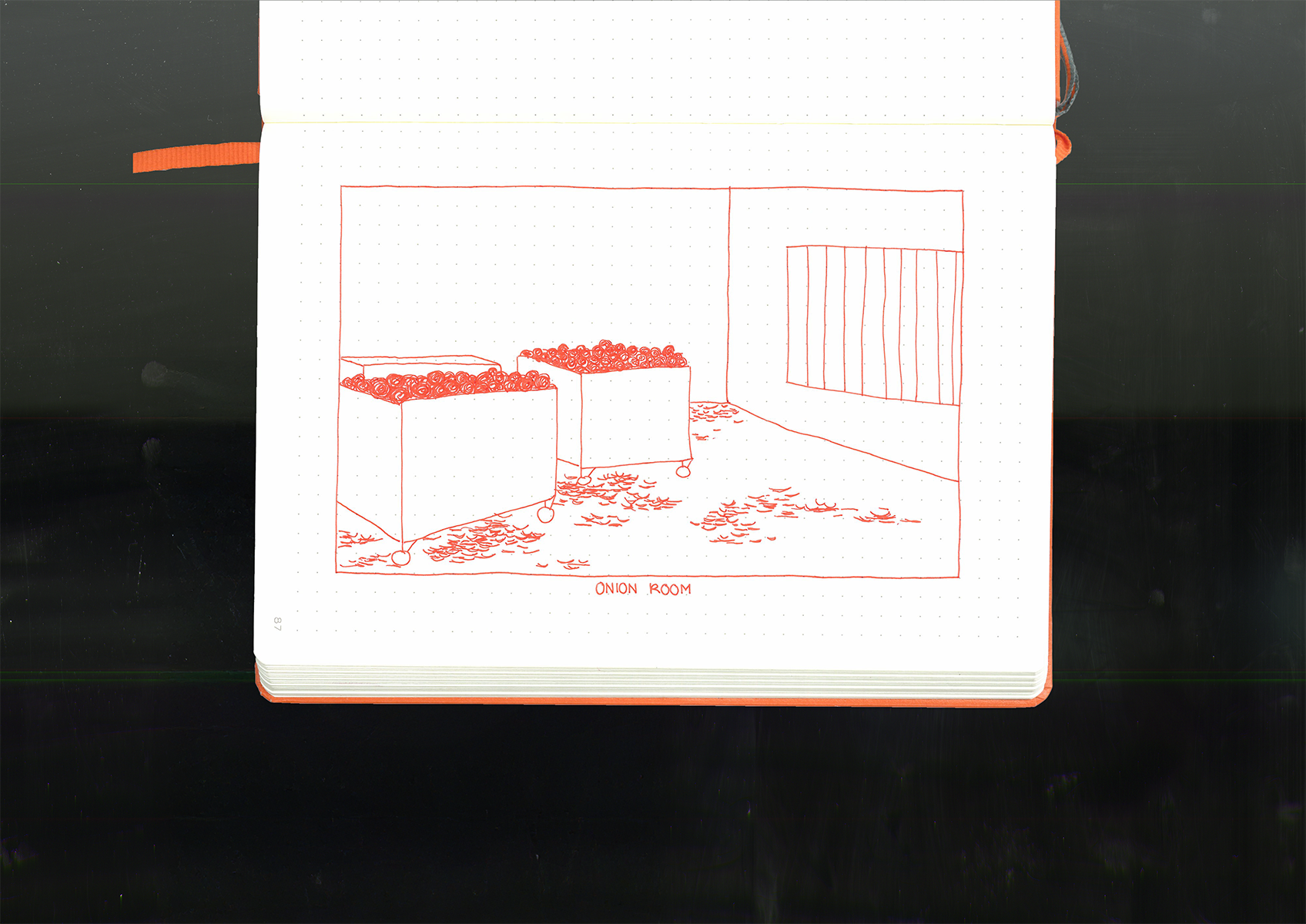
Sketch of the Onion Room, Reconstructed from Memory, Documented during Field Research at Pre-Trial Detention 1, 2025
Space is also shaped by sensory conditions—not only what people see, but what they smell and hear:
Rooms filled with onions. The smell of onions against the exposed concrete. In the onion room, there are containers filled with large white onions, and the flooris covered with onion skins. Six to eight men work here, wearing masks. You can already smell the onions when you arrive on the corridor by elevator, and the work manager's eyes are watering. (Field Report PD1)
The pungent smell of onions penetrates corridors and lingers in the concrete, marking space through odor rather than visual design. It is, however, a familiar smell—one that immediately evokes memories of the world outside.

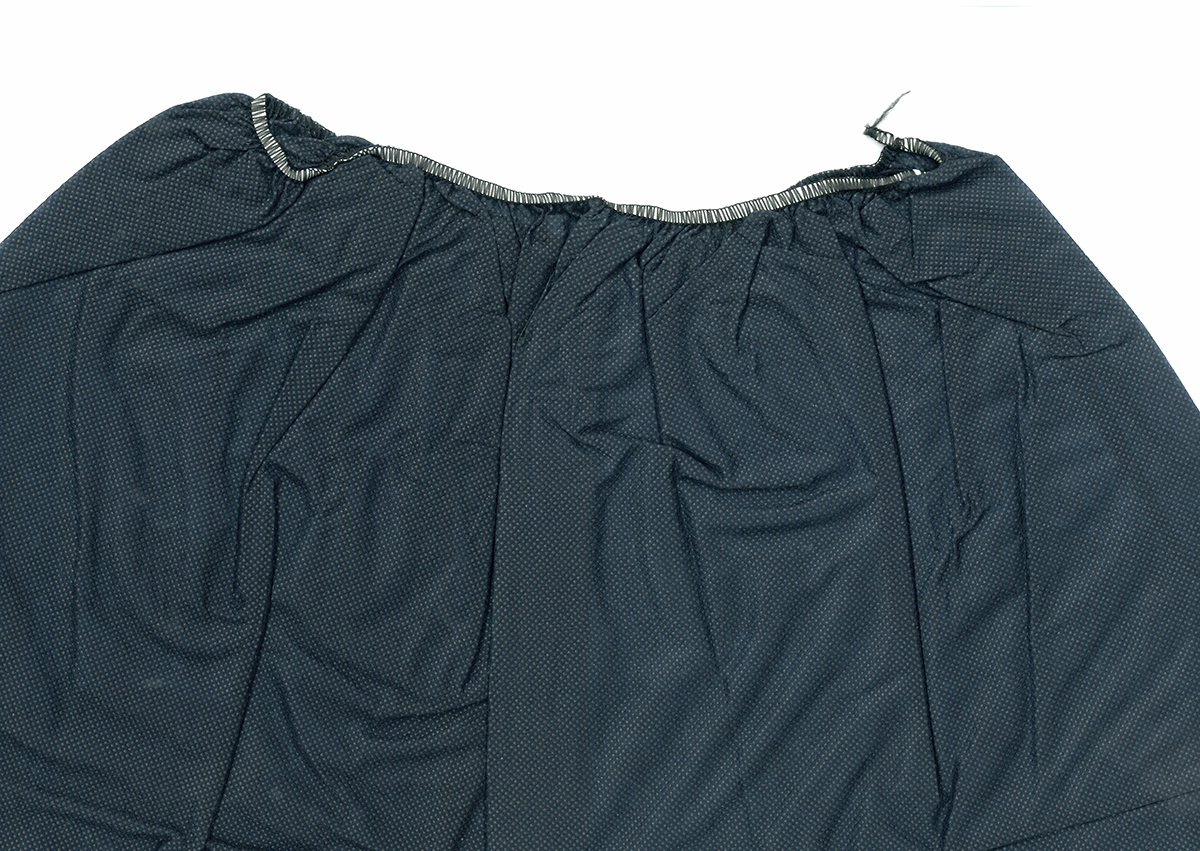
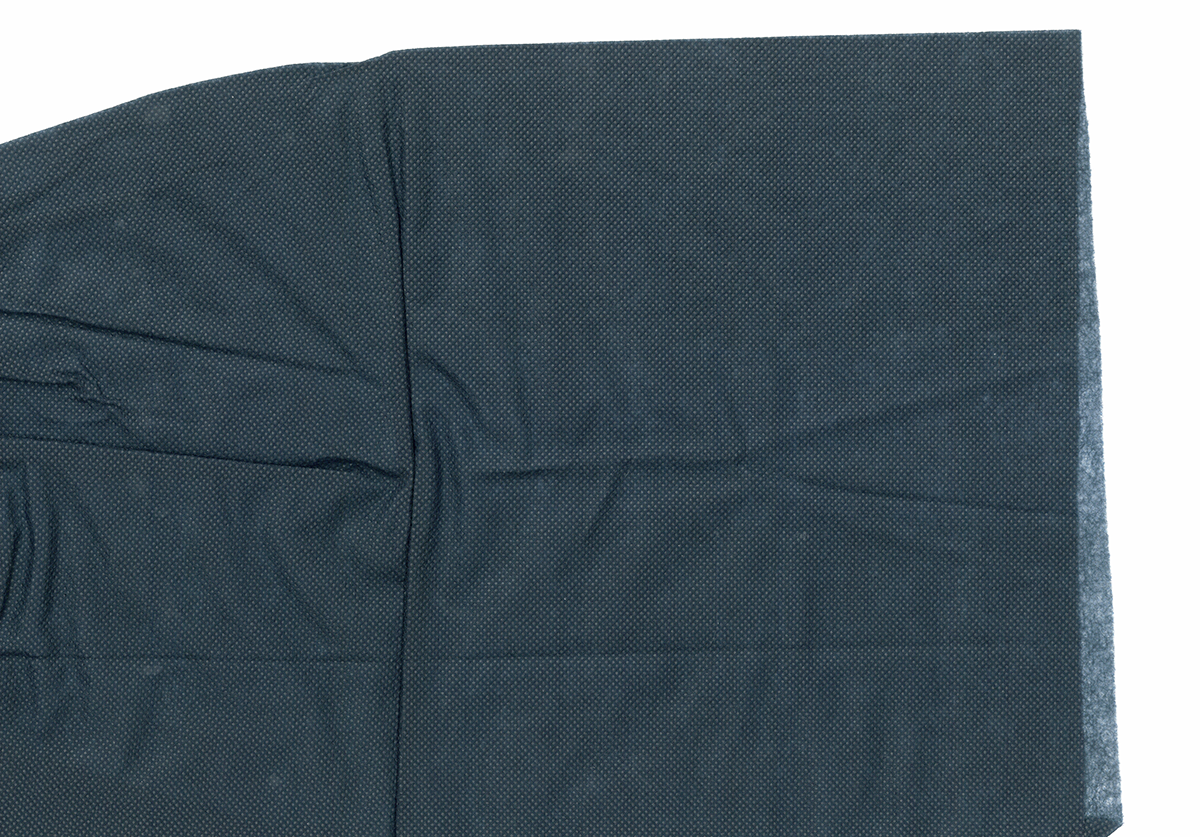
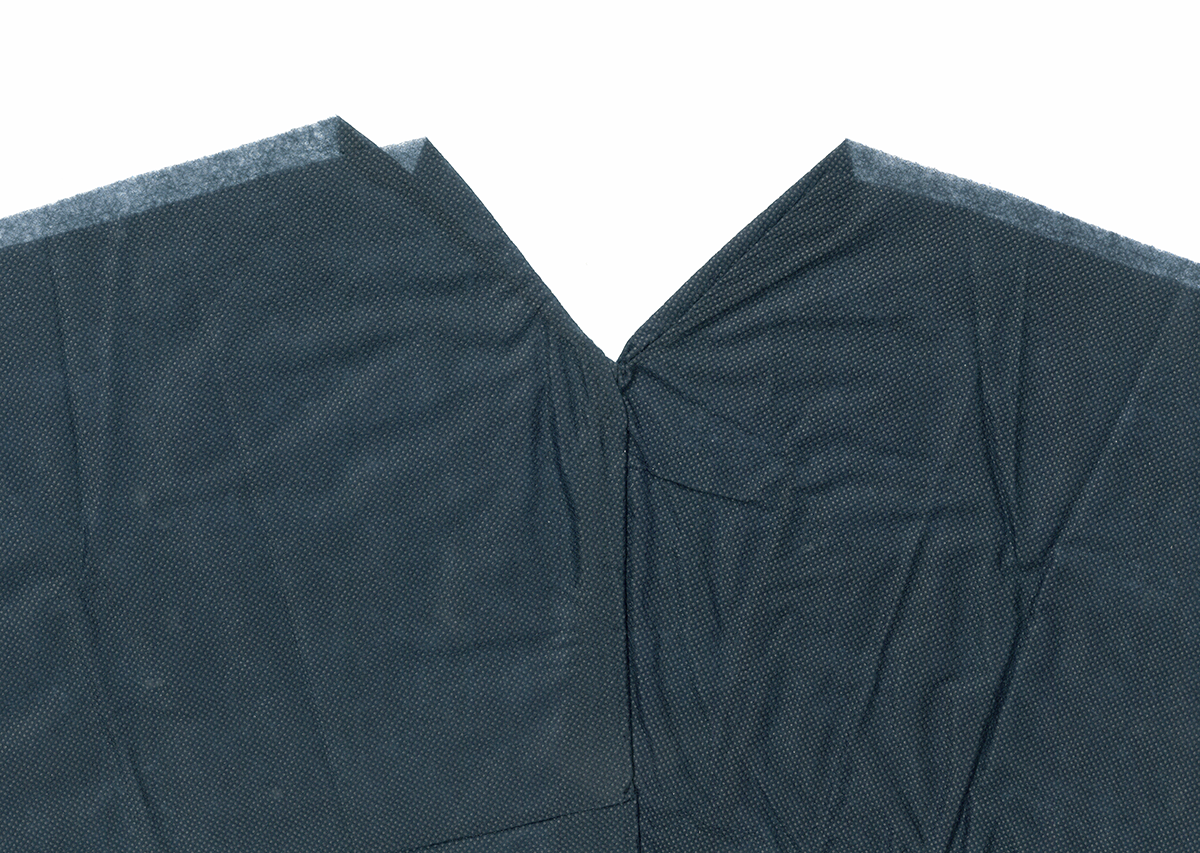
Suicide-Preventive Underwear, Documented during Field Research at Pre-Trial Detention 2, 2025
Psychological Vulnerability
Between 50 and 70 percent of people in pre-trial detention are already struggling with their mental health before they arrive—far more than in the general population. Many are dealing with conditions such as schizophrenia, psychosis, or personality disorders, which the conditions of detention often make worse. As ST explains: “Many overreact very quickly: 'I need acigarette — right now!' This can trigger enormous stress, and a conflict arises just like that. Or someone says: 'The other person took my cigarette!' A world can collapse over something trivial.”
Resilience varies significantly between individuals. While some peopleare, in KR's words, “prison-experienced,” others experience detentionas “sheer hell,” repeatedly falling into crisis. “Nobody is here voluntarily, and people are thrown together here—there are people from allover the world in this place. It is a context of compulsion, even if we allow certain relaxations,” explains KR.
This psychological vulnerability is made visible in the objects theinstitution uses to manage it:
He presses the torn blanket into my hands, along with a pair of underwear wrapped in plastic. He rips open the packaging and tears the underwear as well. The fabric is so thin that it tears immediately, so that inmates cannot use it to hang them selves." (Field Report PD2)
The existence of suicide-preventive underwear in a pre-trial detention facility points to a deep tension within the system. People who have just been detained—potentially in acute distress—are placed in confined spaces and left alone. This raises the question of whether vulnerable individuals are adequately identified and directed to appropriate care. KR is direct about the gap:
“There are simply not enough places in psychiatric facilities. Many people come to useven though detention is far from ideal for their recovery and often exacerbates mental health conditions. Many would actually belong in a clinic, but places there are also scarce. We are seeing an increasing number of mentally disturbed detainees. This has changed significantly compared to ten years ago.”
Suicide-preventive underwear, in this light, is less a solution than a work around—a compensatory measure within a system that lacks the therapeutic capacity it needs.

Reference Image of S-CUT-XC-E Knife, Documented during Field Research at Pre-Trial Detention 2, 2025
© Winther Medical (used with permission)
The same logic extends to people who exhibit aggressive behavior:
Next, we visit the cell for suicidal inmates and those who may pose a danger to others. According to ST, the cells are deliberately designed so that one cannot harm oneself or destroy the cell. Nevertheless, inmates still manage to do so—one of them reportedly dismantled the entire cell. I can easily imagine how anger and despair escalate to extreme levels here. One of the inmates had a psychosis, KR reports. He heard many voices and was very difficult to control. He still had to be granted his one hour of exercise in the yard. “When inmates are not doing well, solitary confinement is the worst, because feelings become stronger and inner voices become much louder and even more unbearable than usual,” says ST. (Field Report PD1)
Next, we look at a cell reserved for particularly aggressive inmates. In the small anteroom, protective equipment for the staff is stored. M shows me a device used to cut clothing off the body. (Field Report PD2)
The tool used to cut clothing from a person's body represents one of the most invasive forms of intervention in the prison—one that entails a direct loss of autonomy and dignity.
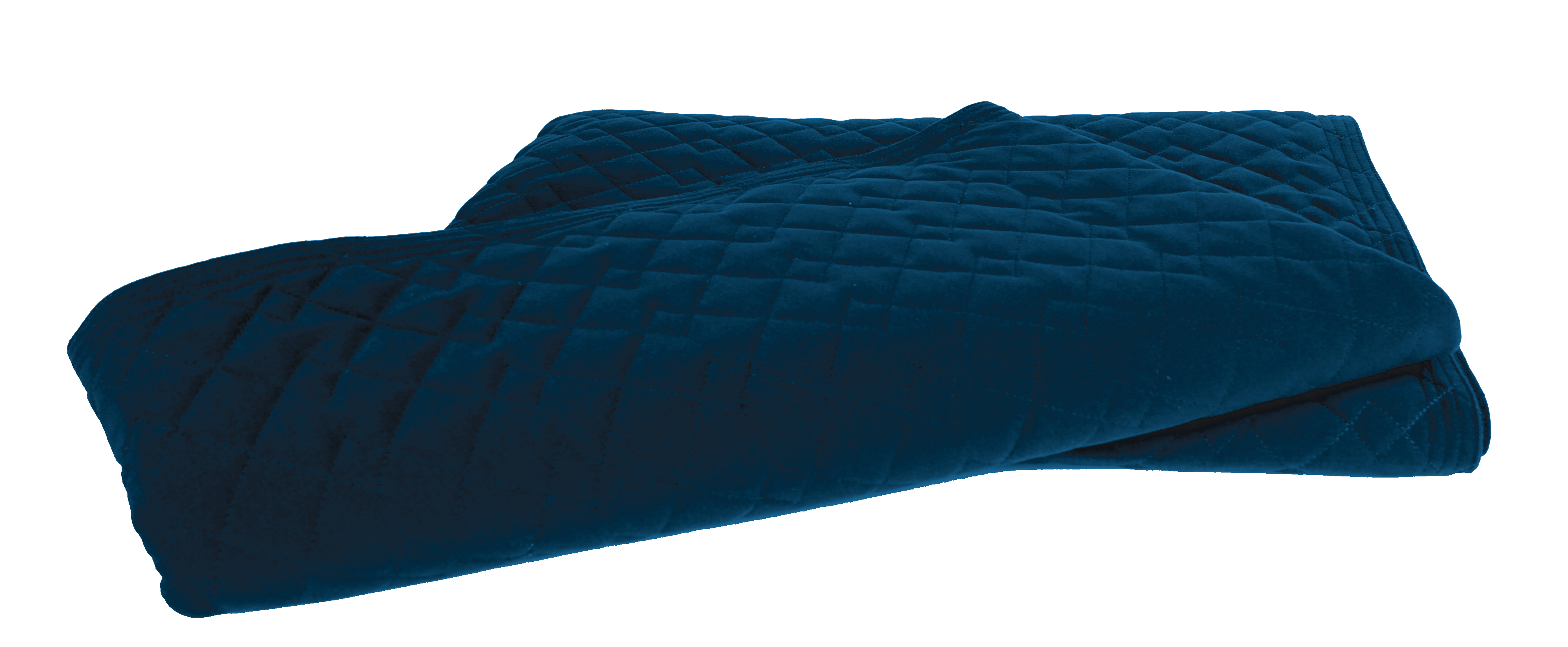
Reference Image of Tear-Resistant blanket, Documented during Field Research at Pre-Trial Detention 2, 2025.
© ATG Kriminaltechnik (used with permission)
On the floor lies a torn mattress inside a sack, and the blanket on the chair is also ripped. The items in this cell must be extremely durable and almost indestructible, as inmates take out their aggression on them, M explains. Although the cell is specifically designed for such cases, there are still individuals who manage to tear everything apart. (Field Report PD2)
The torn blanket is evidence that aggression cannot be fully contained through architecture or material design alone.
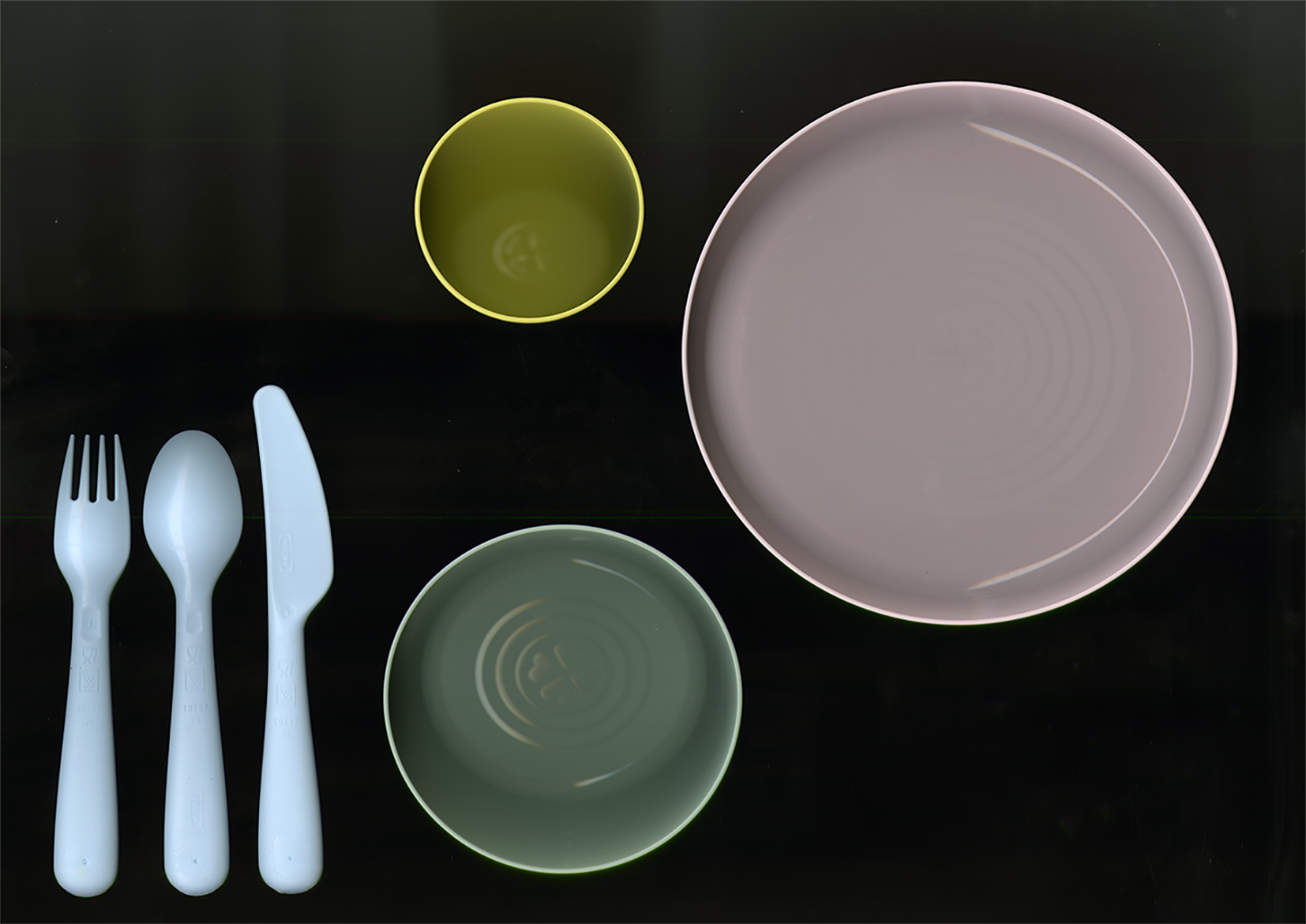
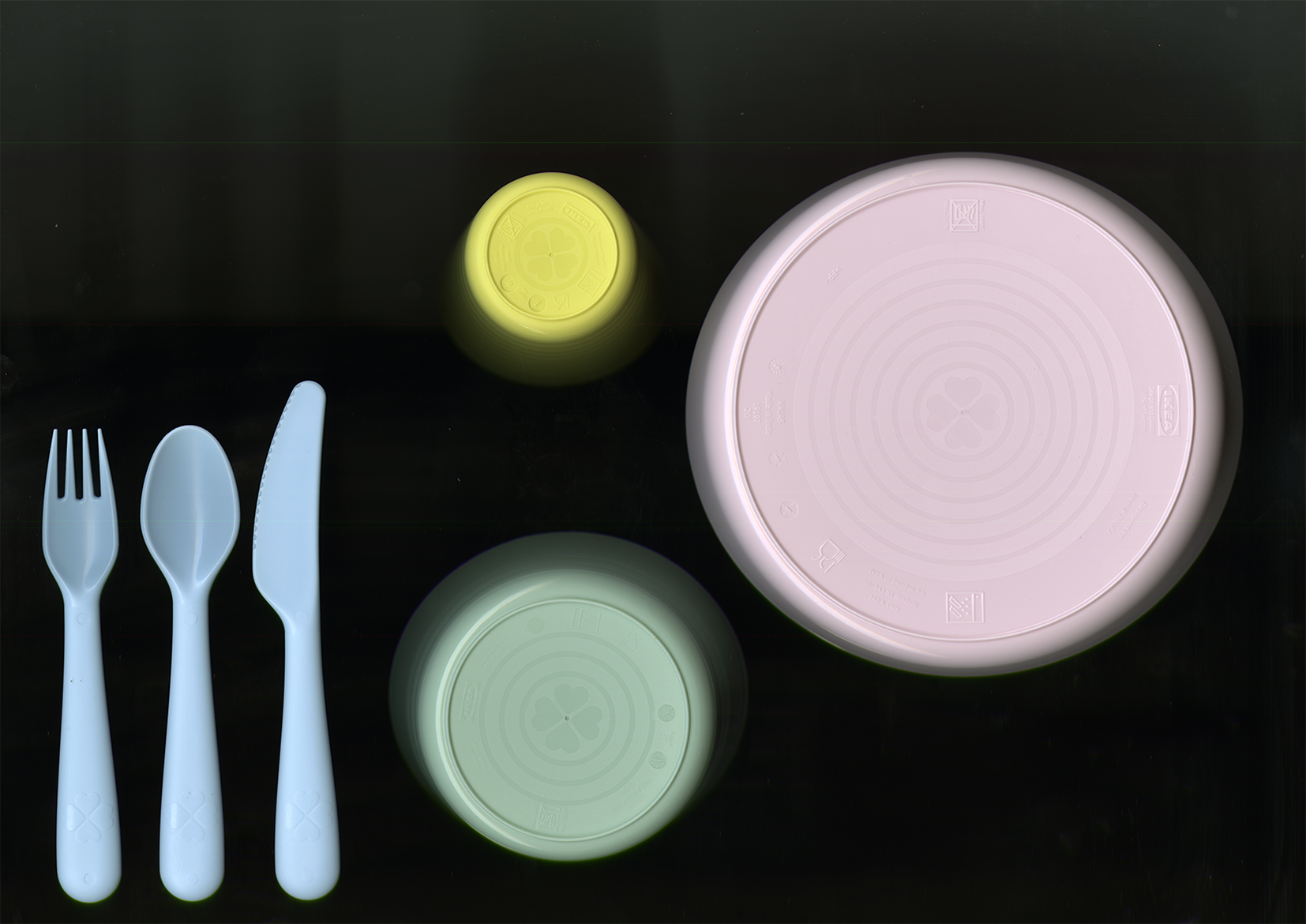
Children's Cutlery from IKEA's Kalas line, Documented during Field Research at Pre-Trial Detention 2, 2025
M unlocks an isolation cell. It is very sparsely furnished: a “bed” with a blanket and a stainless-steel unit that combines a toilet and a sink. There is also a set of plastic tableware—a cup, a bowl, a plate, a knife, a fork, and a spoon—each in a different color; children's cutlery from IKEA. (Field Report PD2)
Pastel-colored children's cutlery in an otherwise grey isolation cell creates a striking contrast. It serves as a risk management measure—plastic, child-safe objects intended to prevent harm—but it also carries a paternalistic undertone. The object positions the person inside as someone in need of both control and protection, showing how care and coercion become difficult to separate within the penal system.
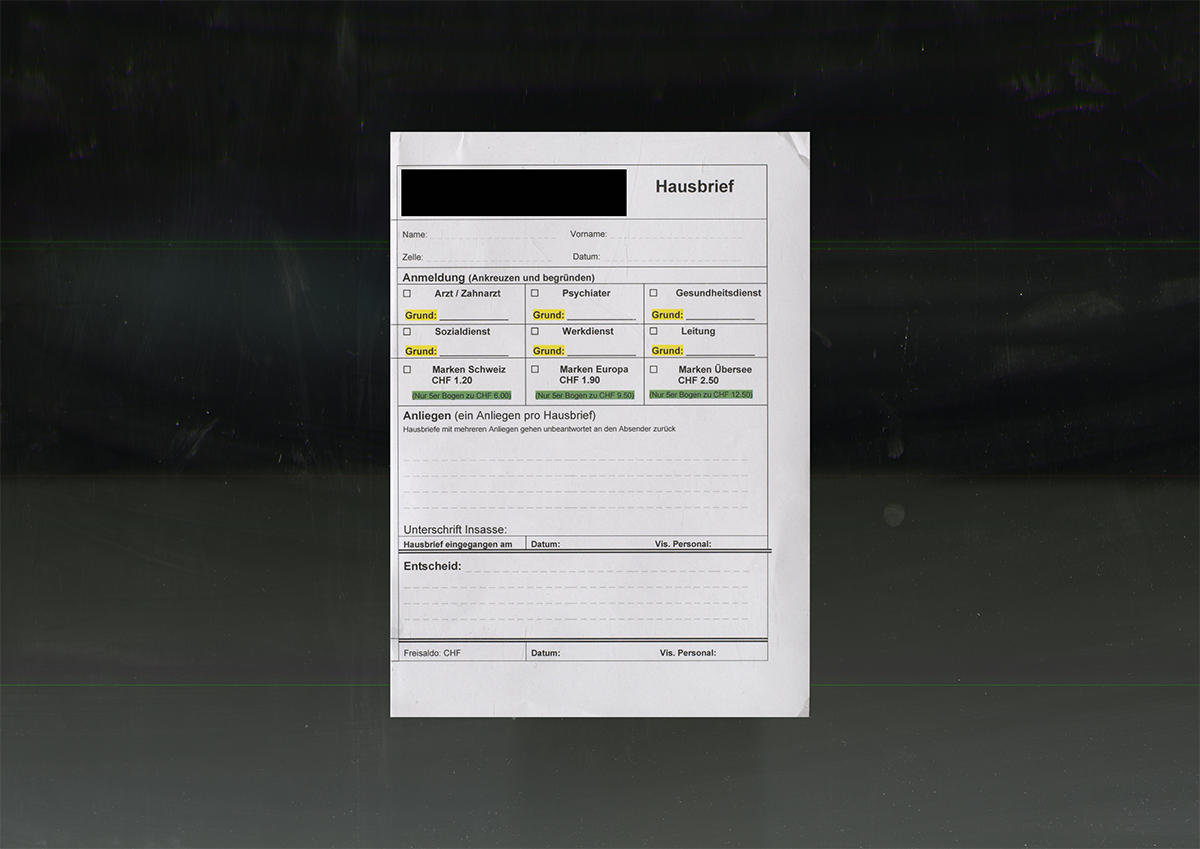
Hausbrief, Documented during Field Research at Pre-Trial Detention 1, 2025
Fragmented Communication
Communication in pre-trial detention is highly structured, slow, and significantly restricted. The central means of communication within the institution is the Hausbrief—a standardized form through which detainees submit requests for medical care, psychological support, or simply to buy stamps. Each form is limited to a single request and requires justification. Even basic needs must be filtered through administrative procedures.
External communication is similarly controlled. Written correspondence is subject to censorship, while visits and phone calls must be approved by the authorities overseeing the case and are often monitored. In many cases, detainees are limited to a single authorized contact. As ST notes, “agreat deal can fall apart within just a few months if administrative processes are not handled quickly and efficiently”—making timely intervention essential to limiting the damage detention causes.
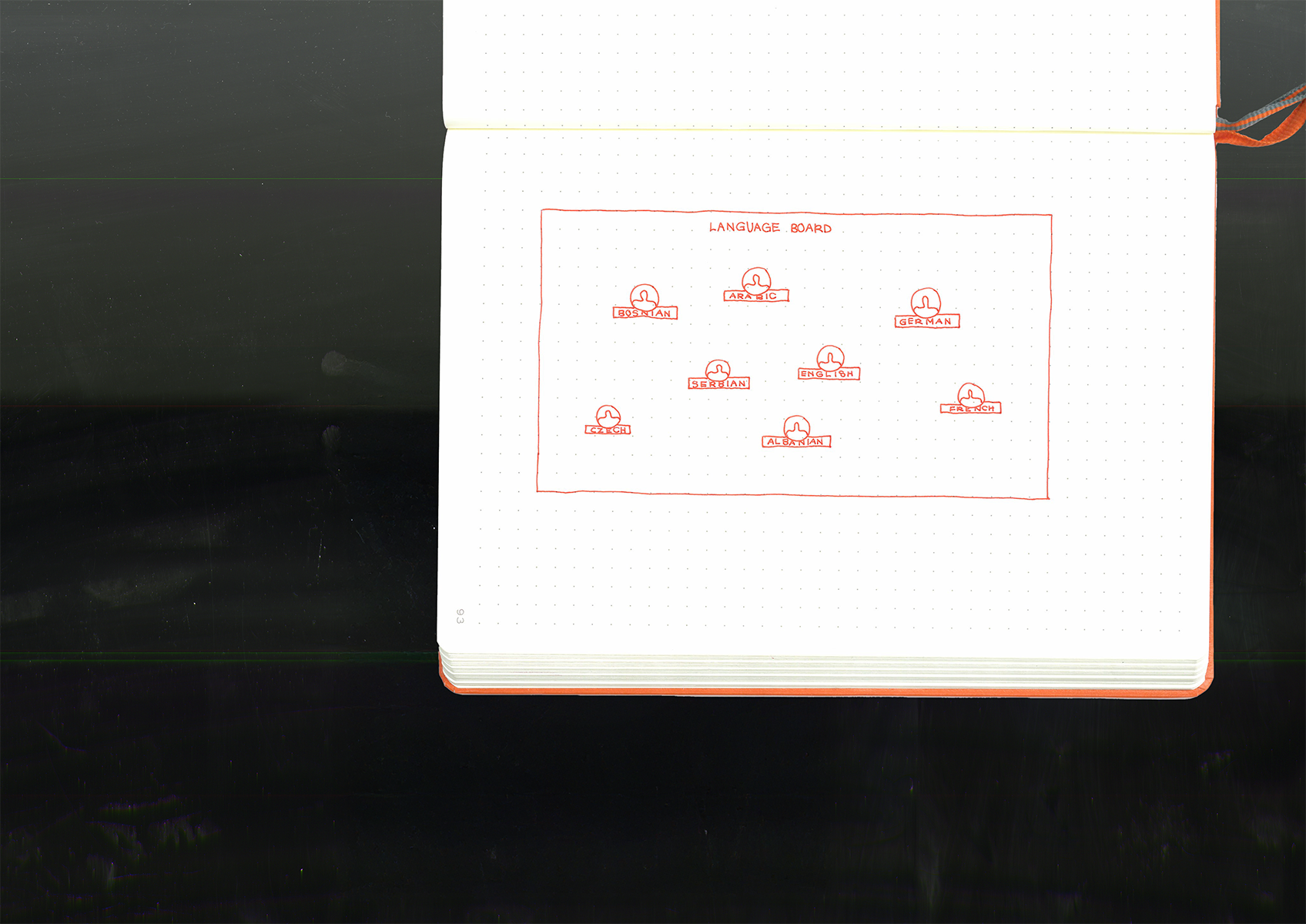
Sketch of Language Board, Reconstructed from Memory, Documented during Field Research at Pre-Trial Detention 2, 2025
Who is Being Punished?
“As for the composition of those detained: around 40 percent are foreign nationals who are registered as residents of a foreign country. The remaining 60 percentlive in Switzerland. Of these, roughly half are foreign nationals with residence in Switzerland; the other half are Swiss citizens—though a not insignificant proportion of these are dual nationals with a migration background.” (ST)
As discussed in the introduction, minorities and migrants are significantly over represented in the Swiss prison system. This imbalance is notonly visible in statistics—it also shows up in the spatial and material organization of the prison itself.
In the office, there is a whiteboard with magnets labeled with the staff members' last names. Under the magnets, slips of paper are attached indicating alanguage. M explains that they had to hire someone specifically who speaks Arabic. (Field Report PD2)
Around twenty different languages are represented on the board. Communication becomes a managed resource that has to be organized and distributed through staff—a quiet but concrete reflection of who is actually inside.
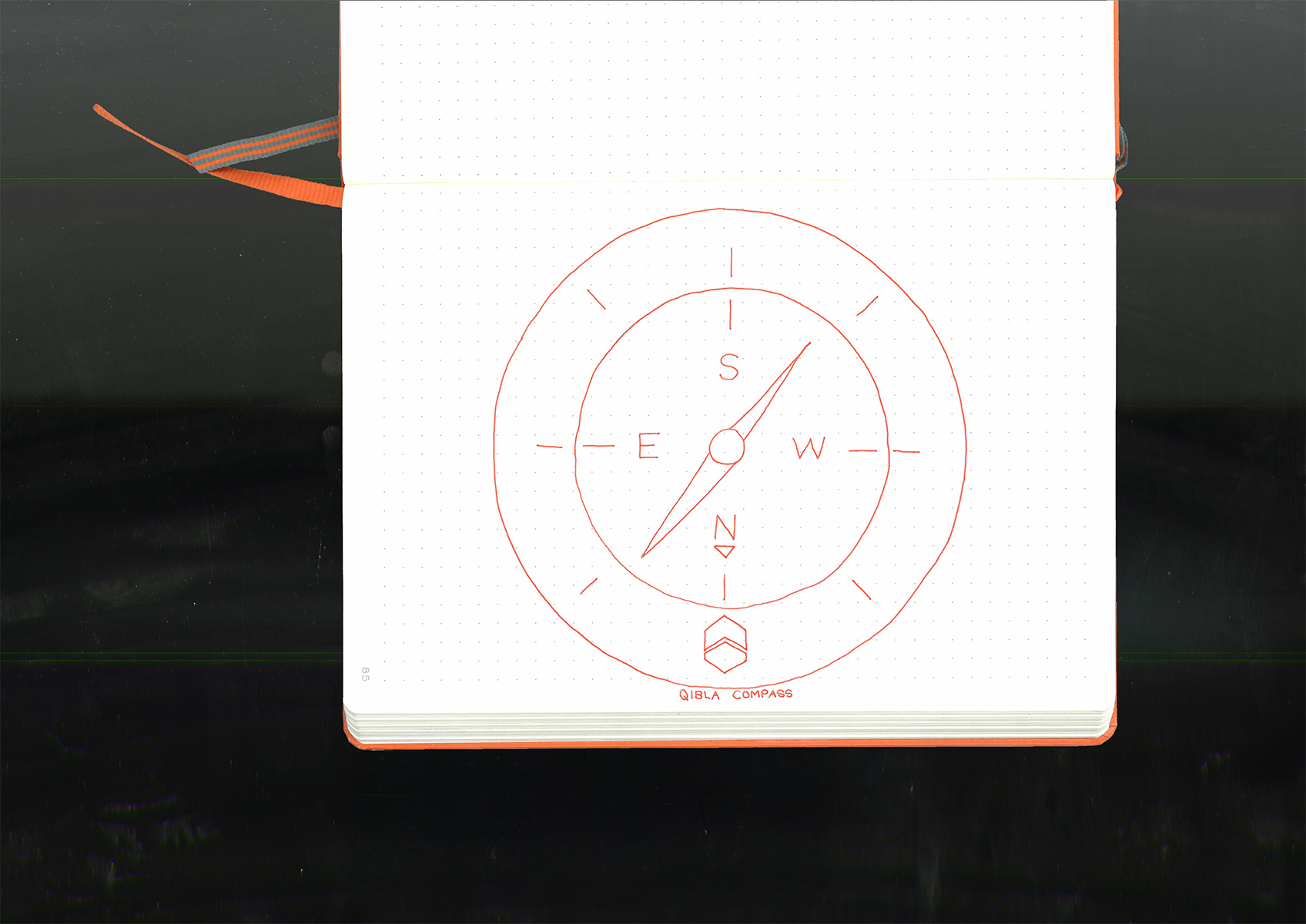
Sketch of Qibla Compass, Reconstructed from Memory, Documented during Field Research at Pre-Trial Detention 1, 2025
In cells at PD1, small Qibla compass stickers indicate the direction of Mecca for Muslim prayer. The stickers reflect an institutional response to the needs of a diverse population and signal a degree of cultural acknowledgment. At the same time, their presence points to the significant number of Muslim inmates in pre-trial detention—an over representation that aligns with the structural inequalities discussed earlier.
One observation from a guard at PD2 adds a further layer of complexity: for some inmates, detention represents a form of relative security—they earn more through prison work than they would in their countries of origin, and have guaranteed access to shelter, food, and basic care. This does not make imprisonment any less punitive. Rather, it shows how the conditions that make prison appear viable for some are themselves products of global inequality. When imprisonment can seem preferable to life outside, the question of who isbeing punished reaches beyond the individual—implicating the broader social and economic structures that determine who ends up inside.
The objects and spaces examined in this chapter show how the penal system becomes visible in material form. Objects designed to protect can also infantilize; measures intended to prevent harm point to the absence of adequate care; systems meantto organize communication further restrict autonomy. Material objects inprisons do more than support institutional routines—they make visible the contradictions at the heart of pre-trial detention, where care and coercion, protection and control, are continuously intertwined.
Field Observation Correctional Facility